
If you’ve ever wondered why your buddy’s ball seems to fly farther even though you swing just as hard, the answer might not be your technique at all — it might be your golf ball. Matching golf ball compression to swing speed is one of the simplest, most overlooked upgrades in golf, and it can be worth real yards without changing a single thing about your swing.
This guide breaks down exactly how swing speed and golf ball selection work together, with charts you can use right away to find your ideal ball, shaft flex, and setup.
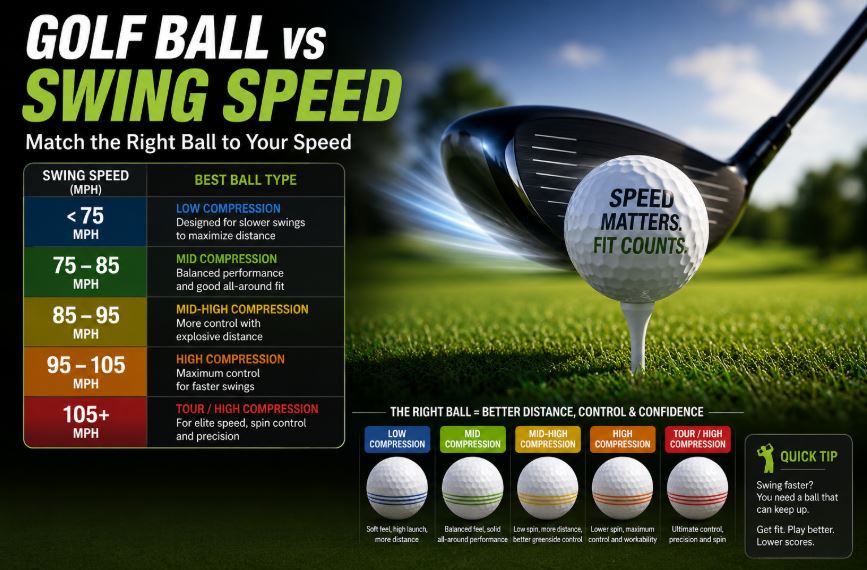
Why Swing Speed Matters More Than You Think
Every golf ball has a compression rating — a measure of how much the ball deforms when your clubface strikes it. Compression ratings generally run from around 30 (very soft) to 120 (very firm).
The idea is simple: your swing speed needs to match that compression range closely enough to compress the ball efficiently at impact.
- Too little swing speed for a firm ball → the ball barely compresses, energy transfer suffers, and you lose distance.
- Too much swing speed for a soft ball → the ball over-compresses, which can flatten trajectory and cost you control.
One important myth to clear up: the old idea that slow swingers “can’t activate the core” of a firmer ball has largely been debunked by modern robot testing.
In general, a firmer ball is a faster ball for players who can generate enough clubhead speed to compress it — but for most recreational golfers, softer, low-compression balls still produce more usable distance because they don’t require as much speed to perform well.
Golf Ball and Swing Speed Chart
Here’s a practical breakdown of compression ranges matched to driver swing speed:
| Driver Swing Speed | Recommended Compression | Ball Type/Feel | Best For |
|---|---|---|---|
| Under 75 mph | Low (30–60) | Very soft, high launch | Beginners, seniors, slower swingers |
| 75–90 mph | Low–Mid (60–80) | Soft to medium feel | Average recreational golfers |
| 90–100 mph | Mid (80–95) | Balanced feel and control | Solid mid-to-low handicappers |
| 100–105 mph | Mid–High (90–100) | Firmer, more control | Strong amateurs, low handicappers |
| 105 mph+ | High (100–120) | Firm, tour-level feel | Elite amateurs, tour-level players |
A good rule of thumb: distance is king below 90 mph, control matters more above 100 mph. If you’re between ranges, lean toward the softer option — you’ll rarely lose meaningful distance, and you’ll gain forgiveness on off-center hits.
It’s also worth noting that compression isn’t the only factor. Cover material (urethane vs. ionomer), the number of layers (2-piece vs. 5-piece), and dimple design all affect spin, feel, and short-game performance — so use compression as your starting point, not your only criterion.
Average Golf Ball Speed by Age
Swing speed — and by extension the golf ball speed it produces — naturally shifts as golfers age. Here’s a general benchmark based on driver swing speed data across age groups (actual results vary with fitness, flexibility, and technique):
| Age Group | Average Driver Swing Speed (Male) | Average Driver Swing Speed (Female) |
|---|---|---|
| Teens–20s | 95–105 mph | 70–80 mph |
| 30s | 93–100 mph | 70–78 mph |
| 40s | 88–95 mph | 68–75 mph |
| 50s | 82–90 mph | 65–72 mph |
| 60s | 78–85 mph | 62–68 mph |
| 70+ | 72–80 mph | 58–65 mph |
Swing speed generally peaks in the late 20s to early 30s, then declines — roughly 1–1.5 mph per decade after 30 — mostly due to reduced hip and shoulder rotation rather than pure strength loss. The encouraging news: golfers who maintain mobility and train specifically for speed often retain 90% or more of their peak swing speed well into their 60s and beyond.
For context, PGA Tour pros average around 113–116 mph, while LPGA Tour pros average roughly 94–96 mph — both far above typical recreational numbers.
Golf Swing Speed Chart for Shaft Flex
Your ball isn’t the only equipment choice tied to swing speed — shaft flex matters just as much, and getting it wrong can cost you even more distance and accuracy than the wrong golf ball. Here’s a general shaft flex chart based on driver swing speed:
| Driver Swing Speed | Recommended Shaft Flex |
|---|---|
| Under 75 mph | Ladies (L) |
| 72–85 mph | Senior (A) |
| 84–96 mph | Regular (R) |
| 95–105 mph | Stiff (S) |
| 105 mph+ | Extra Stiff (X) |
Keep in mind that shaft flex isn’t standardized across manufacturers — a “stiff” shaft from one brand can play more like a “regular” from another. Tempo also matters as much as raw speed: a smooth, slower-transition swing might do better with a softer flex even at a higher swing speed, while an aggressive, quick-transition swing often benefits from something stiffer than the “recommended” number suggests. Treat any shaft flex chart as a starting point for testing, not a final answer.
What Swing Speed Is Right for a Regular Flex Shaft?
This is one of the most searched questions in golf equipment, and for good reason — regular flex covers the range where most recreational golfers actually fall.
Regular flex is generally recommended for driver swing speeds between roughly 84–96 mph. This makes it the most common shaft flex among amateur men and many LPGA Tour players.
A few signs regular flex might be right for you:
- Your driver swing speed measures in the mid-80s to mid-90s mph range
- You find stiffer shafts feel “boardy” and hard to load, leading to low, weak shots
- You’re not generating a particularly fast or aggressive transition from backswing to downswing
If you’re on the border between regular and stiff (around 95 mph), lean toward regular if distance matters more to you, or test stiff if you’re missing shots to the right due to an open face at impact. The only way to know for sure is to hit both on a launch monitor and compare ball speed, dispersion, and launch numbers side by side.
Read also: Golf VS Mini Golf
Golf Ball vs Swing Speed for Irons
Iron swing speeds run noticeably slower than driver speeds — typically 15–25 mph slower depending on the club — because of shorter shafts and higher lofts. That changes how golf ball selection plays out with your irons.
| Club | Typical Speed (vs. 95 mph Driver) | Ball Compression Consideration |
|---|---|---|
| Driver | 95 mph | Baseline for compression fitting |
| 5-iron | ~80 mph | Slightly less compression benefit from firm balls |
| 7-iron | ~75 mph | Mid-compression balls perform well for most golfers |
| 9-iron | ~68 mph | Softer balls often improve feel and stopping power |
| Wedges | 60 mph or less | Cover material (urethane) matters more than compression here |
Here’s the key insight: with irons, spin and feel around the greens usually matter more than raw compression matching. A urethane-covered ball will grip the grooves and generate more spin on wedge shots regardless of your swing speed, while a low-compression, ionomer-covered “distance” ball will fly straighter and spin less — often at the cost of stopping power on the green.
If you’re a slower swinger who struggles to generate spin with wedges, a softer urethane ball (like a 2-piece or 3-piece tour-style ball with a lower compression core) can help you hold greens without needing driver-level swing speed to do it.
How to Actually Find Your Swing Speed
Before you buy anything, you need a real number — guessing based on how far you hit the ball is unreliable.
- Launch monitor — The gold standard. Devices like TrackMan, Garmin R10, or Foresight give accurate clubhead speed, ball speed, and smash factor over multiple swings.
- Driving range simulators — Many ranges now have swing speed radar built in, though these can run 3–7 mph faster than professional launch monitors.
- Carry distance estimate — As a rough guide: a 180-yard carry suggests around 80 mph, 200 yards suggests around 90 mph, and 220 yards suggests around 100 mph. This method is far less precise since it depends heavily on strike quality.
- Club fitting session — A professional fitter will measure your speed and test ball/shaft combinations in real time, which is the most reliable way to get matched correctly.
Quick Recommendations by Swing Speed
- Under 85 mph: Low-compression, 2-piece distance ball + Senior or Ladies flex shaft. Prioritize maximizing ball speed and launch.
- 85–100 mph: Mid-compression ball + Regular flex shaft. This is the sweet spot for most recreational golfers — balance of distance, feel, and control.
- 100 mph+: Mid-to-high compression, urethane-covered ball + Stiff or Extra Stiff shaft. Prioritize control, workability, and greenside spin.
Final Thoughts
Swing speed is the single biggest factor in choosing the right golf ball and shaft setup — but it’s not the only one. Tempo, strike quality, and personal feel preference all play a role, and the “correct” ball on paper isn’t always the one that performs best for your actual swing. The smartest approach: measure your real swing speed, use the charts above as a starting point, then test a sleeve of 2–3 candidate balls in real playing conditions before committing to a dozen.
Get the match right, and you won’t need to change your swing at all to see more distance, better control, and lower scores.