
If you’ve ever stood in the golf shop staring at a wall of dozens of ball options wondering which one actually fits your game, you’re not alone. One of the biggest — and most misunderstood — factors in picking the right ball is golf ball compression vs swing speed. Get this match right, and you’ll pick up distance, better feel, and tighter control. Get it wrong, and you’re leaving yards on the table every single round.
This guide breaks down exactly how compression and swing speed work together, gives you a complete compression chart, and recommends the best balls for every swing speed range — from low compression golf balls for slower swings to firmer 80+ compression balls for tour-level speed.
What Is Golf Ball Compression, Really?
Golf ball compression measures how much a ball deforms when struck. It’s usually expressed as a number between 30 and 100+:
- Low compression (30–70): The ball’s core is softer and compresses easily, even with a slower swing.
- Mid compression (70–90): A balance of softness and energy transfer, suited to moderate swing speeds.
- High compression (90–100+): The ball’s core is firm and needs a fast, powerful swing to compress properly and unlock its full energy transfer.
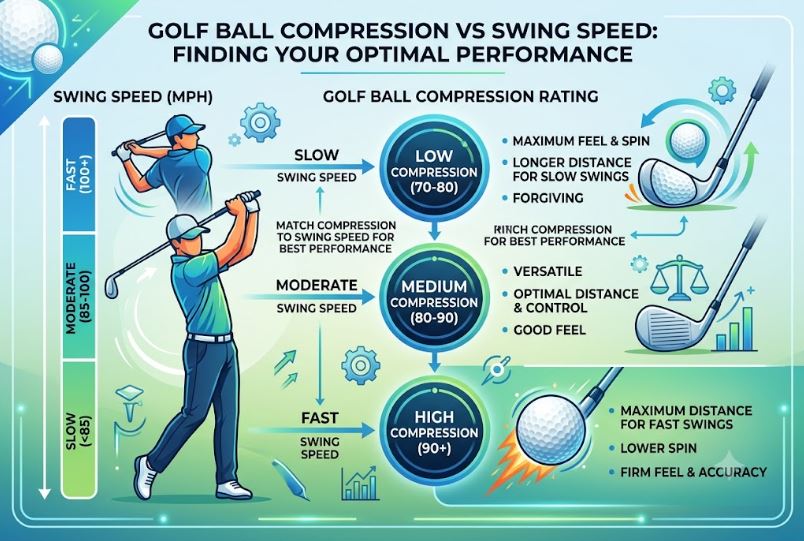
Compression itself isn’t a measure of hardness on the outside — it’s about how the core reacts to impact. A ball that’s compressed correctly returns more energy back into the shot, which means more ball speed and more distance.
Why Swing Speed Matters So Much
Here’s the core relationship: your swing speed determines how much you can actually compress a golf ball.
- If your swing speed is too slow for a high-compression ball, you won’t compress it enough at impact. The result is a “dead” feeling shot, reduced ball speed, and lost distance.
- If your swing speed is too fast for a low-compression ball, you’ll over-compress it, which can cause a loss of control, ballooning shots, and reduced spin consistency around the greens.
In short, matching golf ball compression for swing speed isn’t a marketing gimmick — it’s basic physics, and it directly affects how far and how accurately you hit the golf ball.
Golf Ball Compression vs Swing Speed Chart
Use this golf ball compression vs swing speed chart as a quick reference to find your ideal compression range:
| Swing Speed (Driver, mph) | Recommended Compression | Player Type |
|---|---|---|
| Under 70 mph | 30–50 (Low) | Beginners, seniors, slower-swing players |
| 70–85 mph | 50–70 (Low-Mid) | Casual/average amateur golfers |
| 85–95 mph | 70–90 (Mid) | Solid amateurs, mid-handicappers |
| 95–105 mph | 90–100 (Mid-High) | Low handicappers, strong ball strikers |
| 105 mph+ | 100+ (High) | Tour pros, elite/high-speed swingers |
Quick tip
If you don’t know your exact swing speed, a launch monitor session at a local fitting center or driving range will give you an accurate number in minutes. If your average drive travels under 200 yards, you’re likely in the low-compression range; 200–240 yards typically lines up with mid-compression; and 250+ yards usually calls for higher compression.
Low Compression Golf Balls: Best for Slower Swings
Low compression golf balls (usually 30–60 compression) are designed for players with driver swing speeds under 85 mph. These balls compress easily at impact, which helps slower swingers generate more ball speed and distance than they would with a firmer ball.
Benefits of low compression balls:
- Easier compression at impact means more efficient energy transfer for slower swings
- Softer feel off the clubface, especially useful around the greens
- Often priced more affordably than premium tour balls
Who should use them
Beginners, seniors, junior golfers, and anyone with a smooth, moderate tempo swing under 85 mph.
Mid Compression Golf Balls: The All-Around Choice
Mid compression golf balls (roughly 70–90) are the most popular category because they suit the largest chunk of amateur golfers — those with swing speeds in the 85–100 mph range.
These balls strike a balance: soft enough to compress properly at moderate speeds, but firm enough to hold up on full shots without ballooning. If you’re an average golfer unsure where you fall, starting with a mid compression ball is usually the safest bet.
80 Compression Golf Balls List
An 80 compression rating sits right in the “sweet spot” for a huge number of golfers — moderate-to-above-average swing speeds (roughly 90–100 mph) who want a blend of distance and greenside control. Balls in this range include two- or three-piece constructions designed to balance low spin off the tee with workable spin on approach shots.
When shopping an 80 compression golf balls list, look for:
- A urethane or ionomer cover (urethane gives more short-game spin)
- Multi-layer construction (dual or three-piece cores tend to fall in this range)
- Manufacturer compression ratings listed on the product page or verified through third-party testing, since brands don’t always publish exact numbers
Best 70 Compression Golf Balls
Balls rated around 70 compression are ideal for golfers with driver swing speeds in the 80–90 mph range — a very common speed for recreational and mid-handicap players. The best 70 compression golf balls typically offer:
- A soft, responsive feel on full shots and putts
- Enough firmness to avoid excessive spin or ballooning
- Good all-around performance for players who want distance without sacrificing too much greenside feel
This compression range is often considered the “goldilocks zone” for the average golfer — not so soft that it feels mushy, not so firm that it kills distance.
Low Compression Golf Balls Chart
For golfers specifically hunting in the low compression range, here’s a simplified breakdown:
| Compression Rating | Ideal Swing Speed | Feel |
|---|---|---|
| 30–40 | Under 65 mph | Very soft |
| 40–50 | 65–75 mph | Soft |
| 50–60 | 75–85 mph | Soft-medium |
If your swing speed falls under 85 mph, staying within this low compression golf balls chart range will help you maximize distance and consistency rather than fighting against a ball that’s too firm for your swing.
Callaway Golf Ball Compression Chart
Callaway is one of the most popular ball manufacturers, and its lineup spans the full compression spectrum, making it a great brand to reference when comparing options:
| Callaway Ball Model | Approx. Compression | Best For |
|---|---|---|
| Supersoft | Low (~38) | Slower swing speeds, max distance/feel |
| Reva | Low (~60) | Moderate swing speeds, women’s/beginner-focused |
| Warbird | Low-Mid (~65) | Distance-focused amateurs |
| Chrome Soft | Mid (~75) | All-around amateur and low-handicap play |
| Chrome Soft X | Mid-High (~85) | Faster swingers wanting more control and spin |
| Chrome Tour / Tour X | High (90+) | Elite and tour-level swing speeds |
Note: Compression figures can shift slightly between model years, so always check the current year’s specs before buying.
How to Find Your Ideal Compression Match
- Get your swing speed measured. Many golf retailers and club fitters offer free launch monitor sessions.
- Use the chart above to identify your target compression range.
- Test 2–3 balls within that range on the course, paying attention to distance, feel around the greens, and how consistent your shot dispersion is.
- Reassess periodically. Swing speed can change over time due to fitness, technique changes, age, or injury — so it’s worth rechecking your ideal compression every couple of seasons.
Common Myths About Compression and Swing Speed
“Lower compression always means shorter shots.” Not true — for a slow swing, a low compression ball will usually go farther than a high compression one, because it compresses properly at impact.
“Pros only play high compression because they’re better golfers.” Pros play high compression because their swing speeds are fast enough to compress those firmer balls. It’s not about skill — it’s about physics.
“Compression doesn’t matter if I’m not skilled yet.” Actually, the opposite is true. Beginners and higher handicappers often benefit the most from correct compression matching, since it’s one of the easiest ways to add distance without changing your golf swing.
Final Thoughts
Matching golf ball compression vs swing speed is one of the simplest, most overlooked ways to improve your distance and consistency on the Golf course.
Whether you’re shopping a low compression golf balls chart for a smoother swing, or comparing an 80 compression golf balls list for that competitive sweet spot, the key takeaway is the same: your swing speed should always guide your compression choice — not the other way around.
Take the time to get fitted, test a few options, and let the physics work in your favor.
FAQs
What swing speed do I need for a high compression golf ball?
Generally, you’ll want a driver swing speed of 105 mph or higher to fully compress a high-compression (90+) golf ball.
Can a slow swing speed use a mid compression golf ball?
Yes, but you may not get full compression, which can reduce distance. Mid compression golf balls work best for swing speeds around 85–100 mph.
Does compression affect spin?
Compression affects overall energy transfer and feel more than spin directly. Spin is influenced more by cover material (like urethane vs ionomer) and clubhead loft, though compression can have a secondary effect on shot control.
How do I know my swing speed without a launch monitor?
A rough estimate: divide your average driver distance by roughly 2.3 to 2.5 to estimate mph, though a launch monitor session will always be more accurate.