
A golf handicap is one of the most useful tools in the game. It allows players of very different abilities to compete on equal terms, tracks genuine improvement over time, and makes casual rounds and club competitions fairer and more enjoyable.
Under the modern World Handicap System (WHS), used across the USA, UK, Australia and most of the golfing world, your handicap reflects your potential ability rather than a simple average of every score you post.
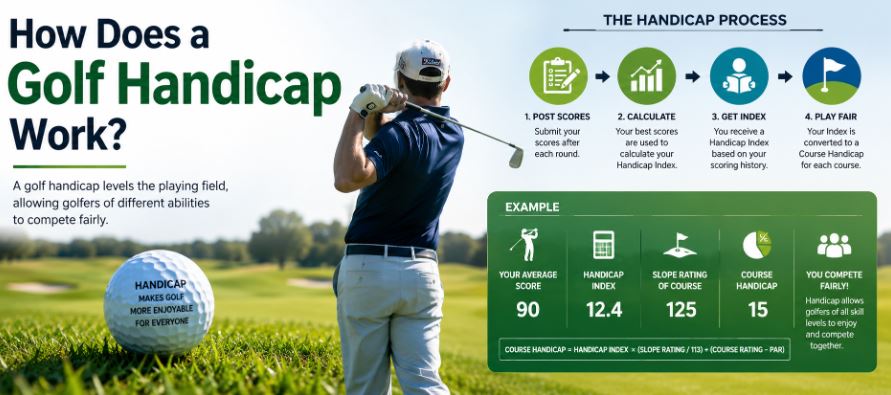
This guide explains exactly how a golf handicap works, how the calculation is done, how it appears on a scorecard, what beginners should expect, regional differences, realistic targets for men and women, and practical advice including whether Kirkland golf balls are good for high handicappers.
What Is a Golf Handicap Index?
Your Handicap Index is a portable number shown to one decimal place. It represents the score you are capable of shooting on a course of standard difficulty (Slope Rating of 113) relative to par on a good day.
- An Index of 0.0 means you are a scratch golfer who typically plays to the Course Rating.
- An Index of 18.0 suggests you would expect to shoot around 18 over par on a standard course when playing well.
- The maximum Handicap Index is 54.0 for both men and women.
The system deliberately uses your better scores so that the Index measures potential rather than everyday average performance. Most golfers only play to their handicap or better about 20–25% of the time.
How Is a Golf Handicap Calculated?
Every acceptable round is first converted into a Score Differential. The official formula is:
Score Differential = (113 ÷ Slope Rating) × (Adjusted Gross Score − Course Rating − PCC)
Here is what each part means in plain language:
- Adjusted Gross Score – Your total strokes after applying the maximum hole score of net double bogey. Net double bogey equals par of the hole + 2 + any handicap strokes you receive on that hole. This rule stops one or two disastrous holes from ruining your differential.
- Course Rating – The expected score for a scratch golfer from the tees you played.
- Slope Rating – A number (usually between 55 and 155) that measures how much harder the course plays for a bogey golfer compared with a scratch golfer. Higher Slope means more strokes for higher-handicap players.
- PCC (Playing Conditions Calculation) – A small daily adjustment (usually between −1 and +3) that accounts for weather, course setup or other conditions that affected scoring that day.
Once you have a Score Differential for each round, the system looks at your most recent 20 scores and averages the best 8. That average becomes your Handicap Index (rounded to one decimal place).
If you have fewer than 20 scores the calculation uses a sliding scale:
- 3 scores → best 1 differential minus 2.0
- 4 scores → best 1 differential minus 1.0
- 5 scores → best 1 differential
- 6 scores → average of best 2 minus 1.0
- and so on until you reach 20 scores and the full “best 8 of 20” method.
Soft and hard caps limit how quickly an Index can rise, and exceptionally low scores can trigger automatic reductions. You need a total of at least 54 holes (any mix of 9-hole and 18-hole rounds) before an official Handicap Index is issued. After that the Index updates daily as new scores are posted.
Course Handicap and Playing Handicap
Your Handicap Index is portable, but the number of strokes you actually receive changes from course to course and tee to tee. That adjusted number is called the Course Handicap.
Course Handicap = Handicap Index × (Slope Rating ÷ 113) + (Course Rating − Par)
This formula does two important things: it scales your Index for the relative difficulty of the tees (via Slope) and then adjusts it relative to the actual par of those tees. The result is rounded to the nearest whole number and tells you how many strokes you receive to play to par on that specific set of tees.
In competitions a further percentage allowance is often applied (for example 85%, 90% or 95% depending on the format). The result is called the Playing Handicap. In general play your Course Handicap simply becomes your Playing Handicap.
Example: Handicap Index 16.4 Slope Rating 128 Course Rating 72.1 Par 72
Course Handicap = 16.4 × (128 ÷ 113) + (72.1 − 72) ≈ 18.6 + 0.1 = 18.7 → rounded to 19.
You would therefore receive 19 strokes on that course.
How Does a Golf Handicap Work on a Scorecard?
Look for the Stroke Index (or Handicap) row printed on the scorecard. Holes are ranked from 1 to 18 according to where a higher-handicap player is most likely to need a stroke in match play (this ranking is not always the same as pure hole difficulty).

- A player with a Course/Playing Handicap of 12 receives one stroke on holes with Stroke Index 1–12.
- A 18-handicapper receives one stroke on every hole.
- A 24-handicapper receives two strokes on the six hardest holes (Stroke Index 1–6) and one stroke on the rest.
On each hole where you receive a stroke (or strokes), you subtract that number from your gross score to produce a net score. The same Stroke Index also tells you which holes allow the higher net double bogey limit when posting scores for handicap purposes.
How Does a Golf Handicap Work for Beginners?
The WHS was designed to be inclusive. Any golfer can obtain a Handicap Index by joining an affiliated club or an official digital service and posting scores that total at least 54 holes.
Typical starting Indexes for complete beginners often fall in the high 20s to mid-30s (sometimes higher). The system uses the graduated calculation described earlier, so your first Index appears as soon as the minimum scores are recorded. From that point every new round updates the number.
Beginners should concentrate on posting honest scores, understanding net double bogey, and playing as many rounds as possible. Rapid early improvement is common once basic contact and short-game skills improve.
How Does a Golf Handicap Work in the USA, UK and Australia?
The underlying mathematics and principles of the World Handicap System are identical in all three countries, which means your Handicap Index is fully portable. Differences exist only in administration and a few local discretionary items:
- USA – Handicaps are managed through the GHIN system administered by the USGA and state/regional associations. Most clubs and many public facilities offer access. Daily revisions and smartphone apps make posting straightforward.
- UK – Each home nation (England Golf, Scottish Golf, Wales Golf, Golf Ireland) runs its own service on the WHS platform. Club membership remains the traditional route, but schemes such as England Golf’s iGolf allow non-members to hold an official Index.
- Australia – Golf Australia operates the GolfLink system. Daily Handicaps are displayed at clubs and the Index follows the same best-8-of-20 method used elsewhere.
Always check the local conditions of competition for any Playing Handicap percentage that may apply on the day.
What Is a Golf Handicap for a Beginner Male?
A realistic first Handicap Index for a beginner male commonly falls between 28 and 36. Scores in the low-to-mid 100s on a standard par-72 Golf course are typical at this stage. With regular play and focused practice many men improve into the low-to-mid 20s within one or two seasons. Reaching under 30 in the first year is already solid progress.
What Is a Golf Handicap for a Beginner Female?
Beginner female golfers frequently start with Indexes in the 32–40 range (sometimes higher). Because the overall female distribution sits higher than the male distribution, a mid-30s starting number is completely normal. Consistent play and short-game work often bring the Index into the high 20s or low 30s within the first couple of years.
What Is a Good Handicap in Golf?
“Good” is relative to experience, age and goals, yet published data from national associations give useful benchmarks:
| Handicap Range | Approximate Standing | Typical Scoring Expectation (par 72) |
|---|---|---|
| + to 0 | Scratch / elite amateur | Near or under par |
| 1–9 | Low / single-digit | Regularly breaks 80 |
| 10–15 | Strong recreational | Mid-to-high 80s |
| 16–20 | Solid mid-handicap | Around 90 |
| 21–28 | Higher handicap | Mid-90s to low 100s |
| 29–54 | Beginner / high handicap | 100+ |
Average Handicap Indexes in many countries sit in the mid-teens for men and the high 20s for women. Moving from the mid-20s into the teens is a realistic and satisfying goal for most club golfers.
Are Kirkland Golf Balls Good for High Handicappers?
Yes — for the majority of high handicappers Kirkland Signature golf balls (particularly the current 3-piece urethane models) are an excellent choice. They combine soft feel, respectable distance, and useful greenside spin at a price far below traditional premium tour balls.
High-handicap players who lose several balls each round benefit from the low cost, which removes the fear of losing expensive balls and encourages freer swings. The urethane cover also helps develop short-game control that cheaper two-piece distance balls cannot provide.
They suit players with moderate swing speeds who want performance without the premium price tag. Golfers with very slow swing speeds or those who lose an unusually large number of balls may still prefer a softer, lower-spin two-piece option. Overall, Kirkland balls remain one of the smartest value choices available for high-handicap and mid-handicap players looking to improve without overspending.
Practical Tips for Using and Improving Your Handicap
- Post every acceptable round as soon as possible.
- Know your Course Handicap and the Stroke Index before you start.
- Apply net double bogey — it protects your Index and speeds up play.
- Track trends over 10–20 rounds rather than reacting to single bad days.
- Prioritise short-game practice; it produces the fastest handicap reduction for most players.
- Review your scoring record periodically; Handicap Committees can make adjustments when needed.
Conclusion
A golf handicap is far more than a number on a card. It is a fair, portable measure of your potential that lets golfers of every level compete together and measure real progress. Under the World Handicap System the calculation of Score Differentials, the averaging of the best eight of the last twenty rounds, and the conversion into Course and Playing Handicaps work the same way whether you play in the USA, the UK or Australia.
Learn how the system functions on the scorecard, post honest scores, and watch the Index respond as your game improves. For high handicappers, sensible equipment choices such as Kirkland golf balls can support that improvement without straining the budget. Start posting, focus on the fundamentals, and enjoy the process — the handicap system is designed to reward steady progress and keep the game accessible and competitive for everyone.